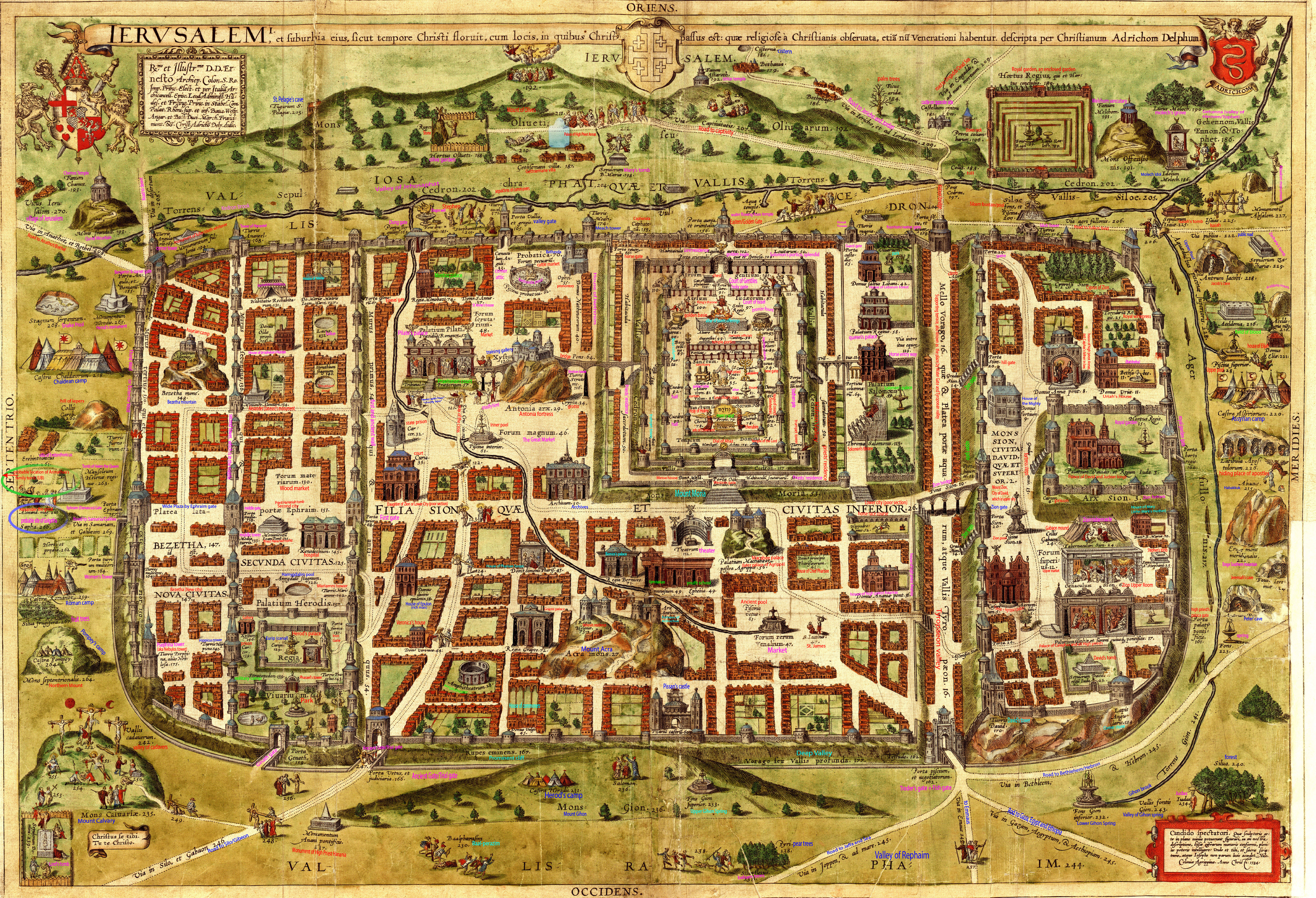
P.1788 – §1 When Jesus started up to Jerusalem with
the ten apostles, he planned to go through Samaria, that being the shorter
route. Accordingly, they passed down the eastern shore of the lake and,
by way of Scythopolis, entered the borders of Samaria. Near nightfall Jesus
sent Philip and Matthew over to a village on the eastern slopes of Mount
Gilboa to secure lodging for the company. It so happened that these villagers
were greatly prejudiced against the Jews, even more so than the average
Samaritans, and these feelings were heightened at this particular time as
so many were on their way to the feast of tabernacles. These people knew
very little about Jesus, and they refused him lodging because he and his
associates were Jews. When Matthew and Philip manifested indignation and
informed these Samaritans that they were declining to entertain the Holy
One of Israel, the infuriated villagers chased them out of the little town
with sticks and stones.
|
|
|
P.1788 – §2 After Philip and Matthew had returned
to their fellows and reported how they had been driven out of the village,
James and John stepped up to Jesus and said: "Master, we pray you
to give us permission to bid fire come down from heaven to devour these
insolent and impenitent Samaritans." But when Jesus heard these words
of vengeance, he turned upon the sons of Zebedee and severely rebuked
them: "You know not what manner of attitude you manifest. Vengeance
savors not of the outlook of the kingdom of heaven. Rather than dispute,
let us journey over to the little village by the Jordan ford." Thus
because of sectarian prejudice these Samaritans denied themselves the
honor of showing hospitality to the Creator Son of a universe.
|
insolent < in (not) + solere (accustomed), 익숙지 않은
ford (여울, 얕은 곳)
|
P.1788 – §3 Jesus and the ten stopped for the night
at the village near the Jordan ford. Early the next day they crossed the
river and continued on to Jerusalem by way of the east Jordan highway,
arriving at Bethany late Wednesday evening. Thomas and Nathaniel arrived
on Friday, having been delayed by their conferences with Rodan. |
|
|
P.1788 – §4 Jesus and the twelve remained in the
vicinity of Jerusalem until the end of the following month (October),
about four and one-half weeks. Jesus himself went into the city only a
few times, and these brief visits were made during the days of the feast
of tabernacles. He spent a considerable portion of October with Abner
and his associates at Bethlehem.
|
vicinity < vicinitas (이웃) |
|
1. THE DANGERS OF THE VISIT TO JERUSALEM – P.1788
P.1788 – §5 Long before they fled from Galilee, the
followers of Jesus had implored him to go to Jerusalem to proclaim the
gospel of the kingdom in order that his message might have the prestige
of having been preached at the center of Jewish culture and learning;
but now that he had actually come to Jerusalem to teach,
P.1789 – §0 they were afraid for his life. Knowing
that the Sanhedrin had sought to bring Jesus to Jerusalem for trial and
recalling the Master’s recently reiterated declarations that he must be
subject to death, the apostles had been literally stunned by his sudden
decision to attend the feast of tabernacles. To all their previous entreaties
that he go to Jerusalem he had replied, "The hour has not yet come."
Now, to their protests of fear he answered only, "But the hour has
come."
|
implorare, beg with tears
reiterate, 되풀이하다
|
|
P.1789 – §1 During the feast of tabernacles Jesus
went boldly into Jerusalem on several occasions and publicly taught in
the temple. This he did in spite of the efforts of his apostles to dissuade
him. Though they had long urged him to proclaim his message in Jerusalem,
they now feared to see him enter the city at this time, knowing full well
that the scribes and Pharisees were bent on bringing about his death.
|
bent on, ~ 하기로 작정한 |
P.1789 – §2 Jesus’ bold appearance in Jerusalem more
than ever confused his followers. Many of his disciples, and even Judas
Iscariot, the apostle, had dared to think that Jesus had fled in haste
into Phoenicia because he feared the Jewish leaders and Herod Antipas.
They failed to comprehend the significance of the Master’s movements.
His presence in Jerusalem at the feast of tabernacles, even in opposition
to the advice of his followers, sufficed forever to put an end to all
whisperings about fear and cowardice.
|
in haste, 급히
Phoenicia, 현대의 레바논 지역
suffice, 충분하다 (동사)
|
|
P.1789 – §3 During the feast of tabernacles, thousands
of believers from all parts of the Roman Empire saw Jesus, heard him teach,
and many even journeyed out to Bethany to confer with him regarding the
progress of the kingdom in their home districts.
|
|
P.1789 – §4 There were many reasons why Jesus was
able publicly to preach in the temple courts throughout the days of the
feast, and chief of these was the fear that had come over the officers
of the Sanhedrin as a result of the secret division of sentiment in their
own ranks. It was a fact that many of the members of the Sanhedrin either
secretly believed in Jesus or else were decidedly averse to arresting
him during the feast, when such large numbers of people were present in
Jerusalem, many of whom either believed in him or were at least friendly
to the spiritual movement which he sponsored. |
own rank, 자신의 계급 |
P.1789 – §5 The efforts of Abner and his associates
throughout Judea had also done much to consolidate sentiment favorable
to the kingdom, so much so that the enemies of Jesus dared not be too
outspoken in their opposition. This was one of the reasons why Jesus could
publicly visit Jerusalem and live to go away. One or two months before
this he would certainly have been put to death.
|
consolidate < con + solidare
gold solidus (콘스탄틴 대제가 발행한 금화), aureus를 대체.
|
|
P.1789 – §6 But the audacious boldness of Jesus in
publicly appearing in Jerusalem overawed his enemies; they were not prepared
for such a daring challenge. Several times during this month the Sanhedrin
made feeble attempts to place the Master under arrest, but nothing came
of these efforts. His enemies were so taken aback by Jesus’ unexpected
public appearance in Jerusalem that they conjectured he must have been
promised protection by the Roman authorities. Knowing that Philip (Herod
Antipas’s brother) was almost a follower of Jesus, the members of the
Sanhedrin speculated that Philip had secured for Jesus promises of protection
against his enemies. Jesus had departed from their jurisdiction before
they awakened to the realization that they had been mistaken in the belief
that his sudden and bold appearance in Jerusalem had been due to a secret
understanding with the Roman officials.
|
audacious 대담한
promise < pro (forward) + mittere (send), 약속하다
|
|
P.1789 – §7 Only the twelve apostles had known that
Jesus intended to attend the feast of tabernacles when they had departed
from Magadan. The other followers of
P.1790 – §0 the Master were greatly astonished when
he appeared in the temple courts and began publicly to teach, and the
Jewish authorities were surprised beyond expression when it was reported
that he was teaching in the temple.
|
|
|
P.1790 – §1 Although his disciples had not expected
Jesus to attend the feast, the vast majority of the pilgrims from afar
who had heard of him entertained the hope that they might see him at Jerusalem.
And they were not disappointed, for on several occasions he taught in
Solomon’s Porch and elsewhere in the temple courts. These teachings were
really the official or formal announcement of the divinity of Jesus to
the Jewish people and to the whole world.
|
중대한 이유: 방문자들이 예수의 말씀을 들을까 희망했다. |
|
P.1790 – §2 The multitudes who listened to the Master’s
teachings were divided in their opinions. Some said he was a good man;
some a prophet; some that he was truly the Messiah; others said he was
a mischievous meddler, that he was leading the people astray with his
strange doctrines. His enemies hesitated to denounce him openly for fear
of his friendly believers, while his friends feared to acknowledge him
openly for fear of the Jewish leaders, knowing that the Sanhedrin was
determined to put him to death. But even his enemies marveled at his teaching,
knowing that he had not been instructed in the schools of the rabbis.
|
denounce < denuntiare < nuntius (messenger) 비난하다. |
P.1790 – §3 Every time Jesus went to Jerusalem, his
apostles were filled with terror. They were the more afraid as, from day
to day, they listened to his increasingly bold pronouncements regarding
the nature of his mission on earth. They were unaccustomed to hearing
Jesus make such positive claims and such amazing assertions even when
preaching among his friends. |
|
|
2. THE FIRST TEMPLE TALK – P.1790
P.1790 – §4 The first afternoon that Jesus taught
in the temple, a considerable company sat listening to his words depicting
the liberty of the new gospel and the joy of those who believe the good
news, when a curious listener interrupted him to ask: "Teacher, how
is it you can quote the Scriptures and teach the people so fluently when
I am told that you are untaught in the learning of the rabbis?" Jesus
replied: "No man has taught me the truths which I declare to you.
And this teaching is not mine but His who sent me.
If any man really desires
to do my Father’s will, he shall certainly know about my teaching, whether
it be God’s or whether I speak for myself. He who speaks for himself seeks
his own glory, but when I declare the words of the Father, I thereby seek
the glory of him who sent me. But before you try to enter into the new
light, should you not rather follow the light you already have? Moses
gave you the law, yet how many of you honestly seek to fulfill its demands?
Moses in this law enjoins you, saying, `You shall not kill’; notwithstanding
this command some of you seek to kill the Son of Man."
|
|
|
P.1790 – §5 When the crowd heard these words, they
fell to wrangling among themselves. Some said he was mad; some that he
had a devil. Others said this was indeed the prophet of Galilee whom the
scribes and Pharisees had long sought to kill. Some said the religious
authorities were afraid to molest him; others thought that they laid not
hands upon him because they had become believers in him. After considerable
debate one of the crowd stepped forward and asked Jesus, "Why do
the rulers seek to kill you?" And he replied: "The rulers seek
to kill me because they resent my teaching about the good news of the
kingdom,
P.1791 – §0 a gospel that sets men free from the
burdensome traditions of a formal religion of ceremonies which these teachers
are determined to uphold at any cost. They circumcise in accordance with
the law on the Sabbath day, but they would kill me because I once on the
Sabbath day set free a man held in the bondage of affliction. They follow
after me on the Sabbath to spy on me but would kill me because on another
occasion I chose to make a grievously stricken man completely whole on
the Sabbath day.
They seek to kill me because they well know that, if
you honestly believe and dare to accept my teaching, their system of traditional
religion will be overthrown, forever destroyed. Thus will they be deprived
of authority over that to which they have devoted their lives since they
steadfastly refuse to accept this new and more glorious gospel of the
kingdom of God. And now do I appeal to every one of you: Judge not according
to outward appearances but rather judge by the true spirit of these teachings;
judge righteously."
|
wrangle, 다투다.
overthrow, 뒤엎다. 전복
|
P.1791 – §1 Then said another inquirer: "Yes,
Teacher, we do look for the Messiah, but when he comes, we know that his
appearance will be in mystery. We know whence you are. You have been among
your brethren from the beginning. The deliverer will come in power to
restore the throne of David’s kingdom. Do you really claim to be the Messiah?"
And Jesus replied: "You claim to know me and to know whence I am.
I wish your claims were true, for indeed then would you find abundant
life in that knowledge. But I declare that I have not come to you for
myself; I have been sent by the Father, and he who sent me is true and
faithful. By refusing to hear me, you are refusing to receive him who
sends me. You, if you will receive this gospel, shall come to know him
who sent me. I know the Father, for I have come from the Father to declare
and reveal him to you." |
lay hands on, 손을 대다, 안수하다 |
|
P.1791 – §2 The agents of the scribes wanted to lay
hands upon him, but they feared the multitude, for many believed in him.
Jesus’ work since his baptism had become well known to all Jewry, and
as many of these people recounted these things, they said among themselves:
"Even though this teacher is from Galilee, and even though he does
not meet all of our expectations of the Messiah, we wonder if the deliverer,
when he does come, will really do anything more wonderful than this Jesus
of Nazareth has already done."
|
메시아가 온다고 예수보다 더한 이적을 행하겠는가? |
|
P.1791 – §3 When the Pharisees and their agents heard
the people talking this way, they took counsel with their leaders and
decided that something should be done forthwith to put a stop to these
public appearances of Jesus in the temple courts. The leaders of the Jews,
in general, were disposed to avoid a clash with Jesus, believing that
the Roman authorities had promised him immunity. They could not otherwise
account for his boldness in coming at this time to Jerusalem; but the
officers of the Sanhedrin did not wholly believe this rumor. They reasoned
that the Roman rulers would not do such a thing secretly and without the
knowledge of the highest governing body of the Jewish nation.
|
forthwith, 당장
authorities, (정부) 당국
account, 설명하다
immunity < immunitas (exemption) 빚을 면제
|
P.1791 – §4 Accordingly, Eber, the proper officer
of the Sanhedrin, with two assistants was dispatched to arrest Jesus.
As Eber made his way toward Jesus, the Master said: "Fear not to
approach me. Draw near while you listen to my teaching. I know you have
been sent to apprehend me, but you should understand that nothing will
befall the Son of Man until his hour comes. You are not arrayed against
me; you come only to do the bidding of your masters, and even these rulers
of the Jews verily think they are doing God’s service when they secretly
seek my destruction.
|
|
|
P.1792 – §1 "I bear none of you ill will. The
Father loves you, and therefore do I long for your deliverance from the
bondage of prejudice and the darkness of tradition. I offer you the liberty
of life and the joy of salvation. I proclaim the new and living way, the
deliverance from evil and the breaking of the bondage of sin. I have come
that you might have life, and have it eternally. You seek to be rid of
me and my disquieting teachings. If you could only realize that I am to
be with you only a little while! In just a short time I go to him who
sent me into this world. And then will many of you diligently seek me,
but you shall not discover my presence, for where I am about to go you
cannot come. But all who truly seek to find me shall sometime attain the
life that leads to my Father’s presence."
|
ill will, 악의
|
|
P.1792 – §3 Eber and his assistants refused to arrest
Jesus; they returned to their meeting place without him. When, therefore,
the chief priests and the Pharisees upbraided Eber and his assistants
because they had not brought Jesus with them, Eber only replied: "We
feared to arrest him in the midst of the multitude because many believe
in him. Besides, we never heard a man speak like this man. There is something
out of the ordinary about this teacher. You would all do well to go over
to hear him." And when the chief rulers heard these words, they were
astonished and spoke tauntingly to Eber: "Are you also led astray?
Are you about to believe in this deceiver? Have you heard that any of
our learned men or any of the rulers have believed in him? Have any of
the scribes or the Pharisees been deceived by his clever teachings?
How
does it come that you are influenced by the behavior of this ignorant
multitude who know not the law or the prophets? Do you not know that such
untaught people are accursed?" And then answered Eber: "Even
so, my masters, but this man speaks to the multitude words of mercy and
hope. He cheers the downhearted, and his words were comforting even to
our souls. What can there be wrong in these teachings even though he may
not be the Messiah of the Scriptures? And even then does not our law require
fairness? Do we condemn a man before we hear him?" And the chief
of the Sanhedrin was wroth with Eber and, turning upon him, said: "Have
you gone mad? Are you by any chance also from Galilee? Search the Scriptures,
and you will discover that out of Galilee arises no prophet, much less
the Messiah."
|
upbraid, 꾸짖다
taunt, 조롱하다
ruler, 회당장
wroth = angry
|
P.1792 – §2 Some of the scoffers said among themselves:
"Where will this man go that we cannot find him? Will he go to live
among the Greeks? Will he destroy himself? What can he mean when he declares
that soon he will depart from us, and that we cannot go where he goes?"
|
|
P.1792 – §4 The Sanhedrin disbanded in confusion,
and Jesus withdrew to Bethany for the night. |
disband, 해산 |
|
3. THE WOMAN TAKEN IN ADULTERY – P.1792
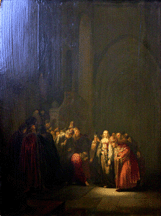
P.1792 – §5 It was during this visit to Jerusalem
that Jesus dealt with a certain woman of evil repute who was brought into
his presence by her accusers and his enemies. The distorted record you
have of this episode would suggest that this woman had been brought before
Jesus by the scribes and Pharisees, and that Jesus so dealt with them
as to indicate that these religious leaders of the Jews might themselves
have been guilty of immorality. Jesus well knew that, while these scribes
and Pharisees were spiritually blind and intellectually prejudiced by
their loyalty to tradition, they were to be numbered among the most thoroughly
moral men of that day and generation.
|
evil repute, 악명 |
|
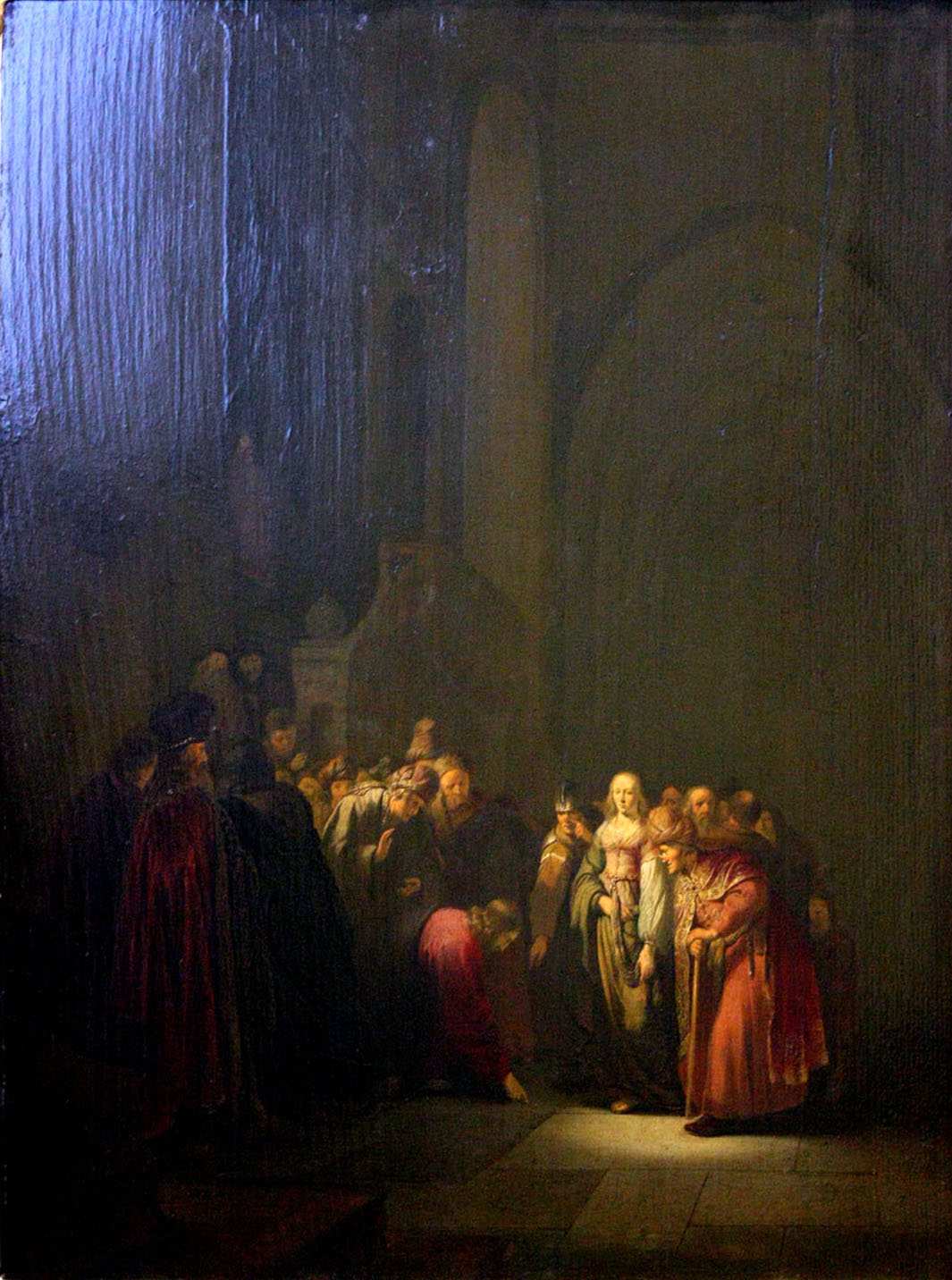
P.1793 – §1 What really happened was this: Early
the third morning of the feast, as Jesus approached the temple, he was
met by a group of the hired agents of the Sanhedrin who were dragging
a woman along with them. As they came near, the spokesman said: "Master,
this woman was taken in adultery–in the very act. Now, the law of Moses
commands that we should stone such a woman. What do you say should be
done with her?"
|
in the very act, 현장에서 |
P.1793 – §2 It was the plan of Jesus’ enemies, if
he upheld the law of Moses requiring that the self-confessed transgressor
be stoned, to involve him in difficulty with the Roman rulers, who had
denied the Jews the right to inflict the death penalty without the approval
of a Roman tribunal. If he forbade stoning the woman, they would accuse
him before the Sanhedrin of setting himself up above Moses and the Jewish
law. If he remained silent, they would accuse him of cowardice. But the
Master so managed the situation that the whole plot fell to pieces of
its own sordid weight.
|
inflict, 해를 가하다
fall to pieces, 가루가 되다
|
|
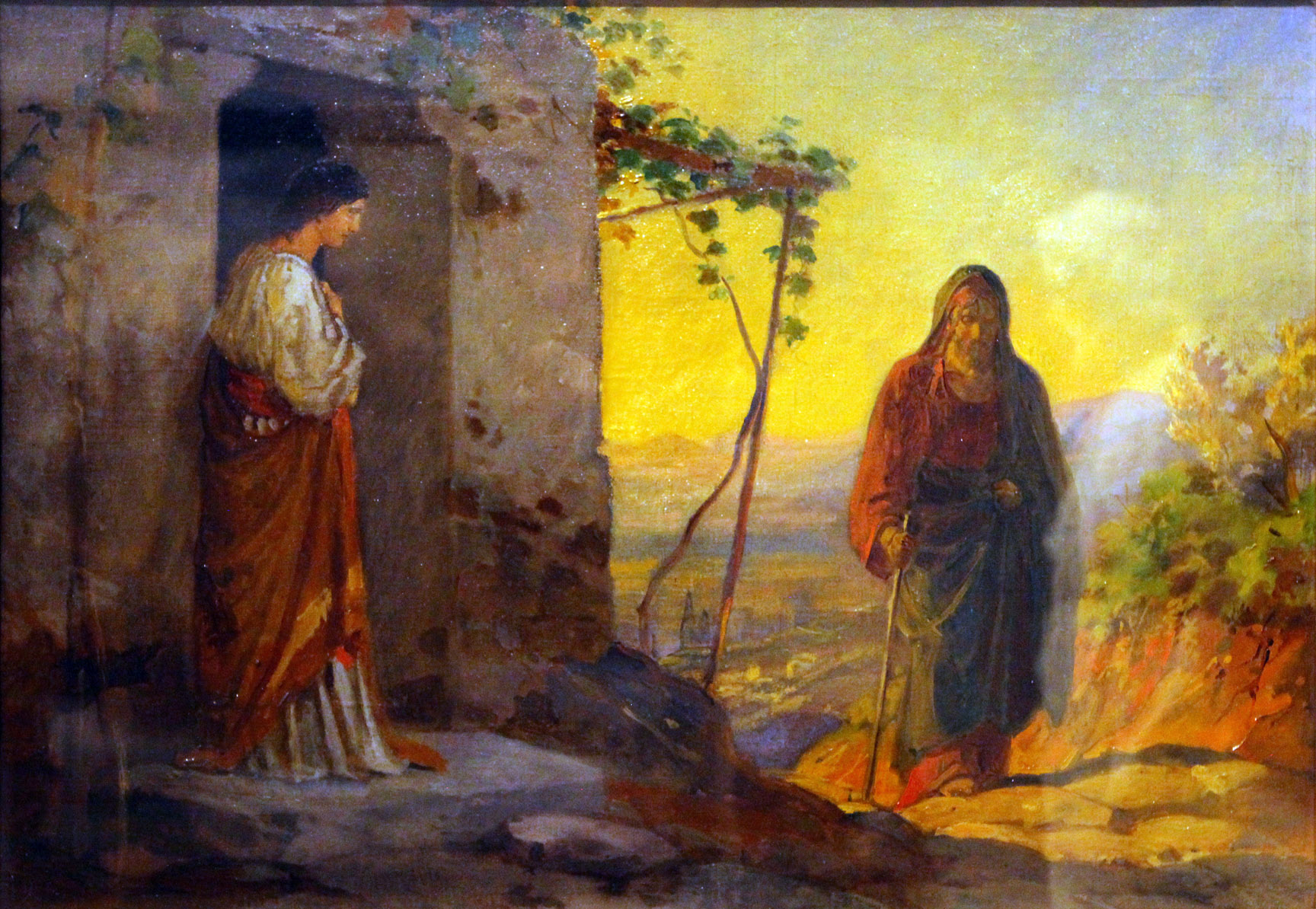
P.1793 – §3 This woman, once comely, was the wife
of an inferior citizen of Nazareth, a man who had been a troublemaker
for Jesus throughout his youthful days. The man, having married this woman,
did most shamefully force her to earn their living by making commerce
of her body. He had come up to the feast at Jerusalem that his wife might
thus prostitute her physical charms for financial gain. He had entered
into a bargain with the hirelings of the Jewish rulers thus to betray
his own wife in her commercialized vice. And so they came with the woman
and her companion in transgression for the purpose of ensnaring Jesus
into making some statement which could be used against him in case of
his arrest.
|
comely, 잘 생긴
ensnare 덫에 옭아매다
|
|
P.1793 – §4 Jesus, looking over the crowd, saw her
husband standing behind the others. He knew what sort of man he was and
perceived that he was a party to the despicable transaction. Jesus first
walked around to near where this degenerate husband stood and wrote upon
the sand a few words which caused him to depart in haste. Then he came
back before the woman and wrote again upon the ground for the benefit
of her would-be accusers; and when they read his words, they, too, went
away, one by one. And when the Master had written in the sand the third
time, the woman’s companion in evil took his departure, so that, when
the Master raised himself up from this writing, he beheld the woman standing
alone before him.
Jesus said: "Woman, where are your accusers? did
no man remain to stone you?" And the woman, lifting up her eyes,
answered, "No man, Lord." And then said Jesus: "I know
about you; neither do I condemn you. Go your way in peace." And this
woman, Hildana, forsook her wicked husband and joined herself to the disciples
of the kingdom.
|
 despicable < despicari, 멸시하다 despicable < despicari, 멸시하다
|
|
4. THE FEAST OF TABERNACLES – P.1793
P.1793 – §5 The presence of people from all of the
known world, from Spain to India, made the feast of tabernacles an ideal
occasion for Jesus for the first time publicly to proclaim his full gospel
in Jerusalem. At this feast the people lived much in the open air, in
leafy booths. It was the feast of the harvest ingathering, and coming,
as it did, in the cool of the autumn months, it was more generally attended
by the Jews of the world than was the Passover at the end of the winter
or Pentecost at the beginning of summer. The apostles at last beheld their
Master making the bold announcement of his mission on earth before all
the world, as it were.
|
as it were |
|
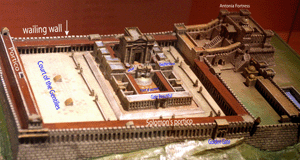
P.1794 – §1 This was the feast of feasts, since any
sacrifice not made at the other festivals could be made at this time.
This was the occasion of the reception of the temple offerings; it was
a combination of vacation pleasures with the solemn rites of religious
worship. Here was a time of racial rejoicing, mingled with sacrifices,
Levitical chants, and the solemn blasts of the silvery trumpets of the
priests. At night the impressive spectacle of the temple and its pilgrim
throngs was brilliantly illuminated by the great candelabras which burned
brightly in the court of the women as well as by the glare of scores of
torches standing about the temple courts. The entire city was gaily decorated
except the Roman castle of Antonia, which looked down in grim contrast
upon this festive and worshipful scene. And how the Jews did hate this
ever-present reminder of the Roman yoke!
|
candelabra, (일곱 초를 켜 놓는) 촛대
|
| |
|
|
|
|
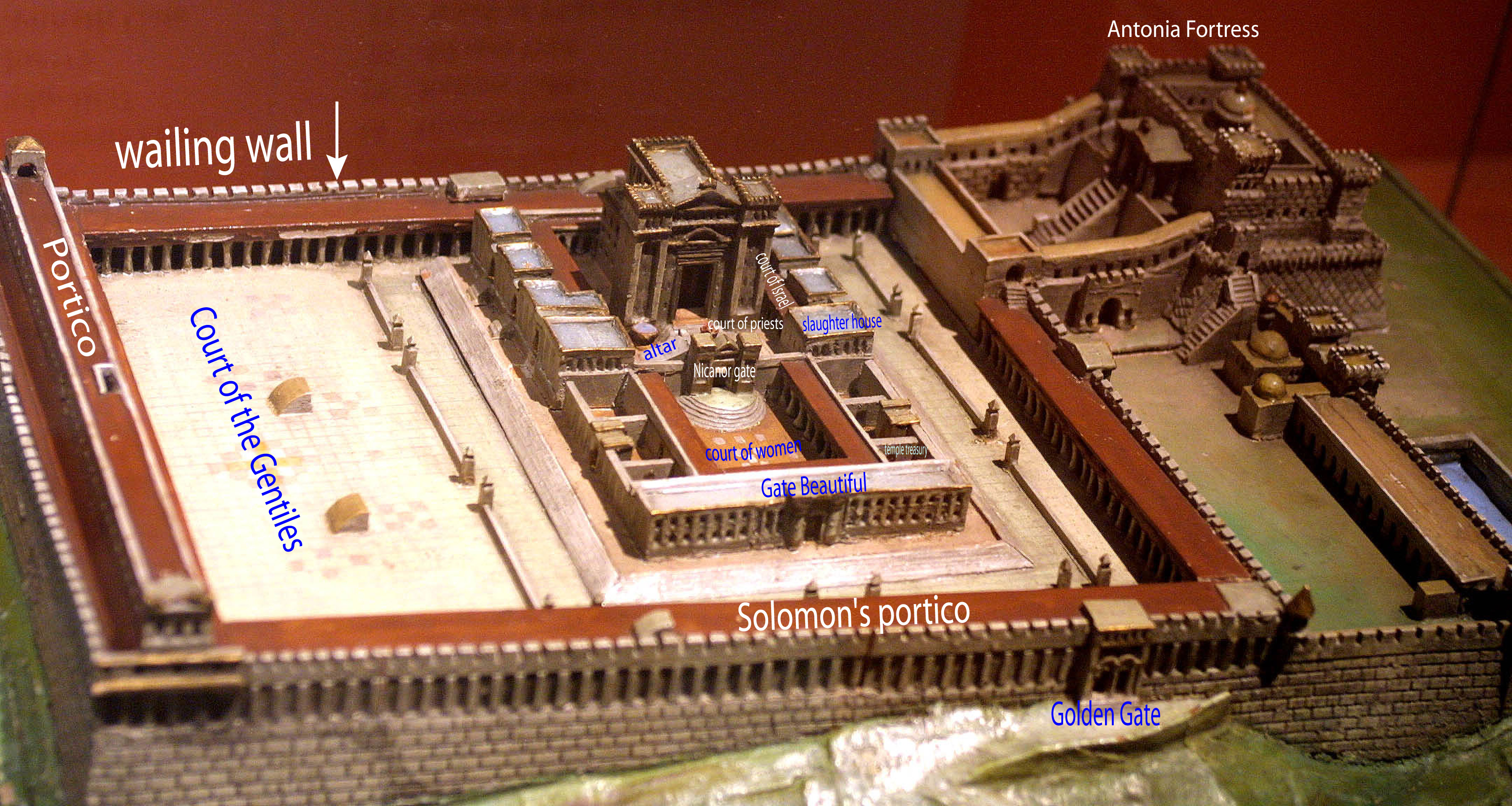
P.1794 – §2 Seventy bullocks were sacrificed during
the feast, the symbol of the seventy nations of heathendom. The ceremony
of the outpouring of the water symbolized the outpouring of the divine spirit.
This ceremony of the water followed the sunrise procession of the priests
and Levites. The worshipers passed down the steps leading from the court
of Israel to the court of the women while successive blasts were blown upon
the silvery trumpets. And then the faithful marched on toward the beautiful
gate, which opened upon the court of the gentiles. Here they turned about
to face westward, to repeat their chants, and to continue their march for
the symbolic water.
|
beautiful gate = golden gate = 미문
|
|
P.1794 – §3 On the last day of the feast almost
four hundred and fifty priests with a corresponding number of Levites
officiated. At daybreak the pilgrims assembled from all parts of the city,
each carrying in the right hand a sheaf of myrtle, willow, and palm branches,
while in the left hand each one carried a branch of the paradise apple–the
citron, or the "forbidden fruit." These pilgrims divided into
three groups for this early morning ceremony. One band remained at the
temple to attend the morning sacrifices; another group marched down below
Jerusalem to near Maza to cut the willow branches for the adornment of
the sacrificial altar, while the third group formed a procession to march
from the temple behind the water priest, who, to the sound of the silvery
trumpets, bore the golden pitcher which was to contain the symbolic water,
out through Ophel to near Siloam, where was located the fountain gate.
After the golden pitcher had been filled at the pool of Siloam, the procession
marched back to the temple, entering by way of the water gate and going
directly to the court of the priests, where the priest bearing the water
pitcher was joined by the priest bearing the wine for the drink offering.
These two priests then repaired to the silver funnels leading to the base
of the altar and poured the contents of the pitchers therein. The execution
of this rite of pouring the wine and the water was the signal for the
assembled pilgrims to begin the chanting of the Psalms from 113 to 118
inclusive, in alternation with the Levites. And as they repeated these
lines, they would wave their sheaves at the altar. Then followed the sacrifices
for the day, associated with the repeating of the Psalm for the day, the
Psalm for the last day of the feast being the eighty-second, beginning
with the fifth verse.
|
officiate, 행사를 주관하다
도금양 (작은 흰꽃이 피는 식물)
Maza, 성묘
repair = go
funnel, 깔대기
sheaf, 다발
|
|
5. SERMON ON THE LIGHT OF THE WORLD – P.1794
P.1794 – §4 On the evening of the next to the last
day of the feast, when the scene was brilliantly illuminated by the lights
of the candelabras and the torches, Jesus stood up in the midst of the
assembled throng and said:
P.1795 – §1 "I am the light of the world. He
who follows me shall not walk in darkness but shall have the light of
life. Presuming to place me on trial and assuming to sit as my judges,
you declare that, if I bear witness of myself, my witness cannot be true.
But never can the creature sit in judgment on the Creator. Even if I do
bear witness about myself, my witness is everlastingly true, for I know
whence I came, who I am, and whither I go. You who would kill the Son
of Man know not whence I came, who I am, or whither I go. You judge only
by the appearances of the flesh; you do not perceive the realities of
the spirit.
|
on, (주제)에 관한
have the light, 생명의 빛을 받으리라
|
|
I judge no man, not even my archenemy. But if I should choose
to judge, my judgment would be true and righteous, for I would judge not
alone but in association with my Father, who sent me into the world, and
who is the source of all true judgment. You even allow that the witness
of two reliable persons may be accepted–well, then, I bear witness of
these truths; so also does my Father in heaven. And when I told you this
yesterday, in your darkness you asked me, `Where is your Father?’ Truly,
you know neither me nor my Father, for if you had known me, you would
also have known the Father.
|
archenemy, 대적 |
|
P.1795 – §2 "I have already told you that I am
going away, and that you will seek me and not find me, for where I am going
you cannot come. You who would reject this light are from beneath; I am
from above. You who prefer to sit in darkness are of this world; I am not
of this world, and I live in the eternal light of the Father of lights.
You all have had abundant opportunity to learn who I am, but you shall have
still other evidence confirming the identity of the Son of Man. I am the
light of life, and every one who deliberately and with understanding rejects
this saving light shall die in his sins. Much I have to tell you, but you
are unable to receive my words. However, he who sent me is true and faithful;
my Father loves even his erring children. And all that my Father has spoken
I also proclaim to the world.
|

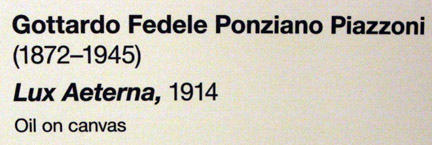
영원한 빛
|
|
P.1795 – §3 "When the Son of Man is lifted
up, then shall you all know that I am he, and that I have done nothing
of myself but only as the Father has taught me. I speak these words to
you and to your children. And he who sent me is even now with me; he has
not left me alone, for I do always that which is pleasing in his sight."
P.1795 – §4 As Jesus thus taught the pilgrims in
the temple courts, many believed. And no man dared to lay hands upon him.
|
|
|
6. DISCOURSE ON THE WATER OF LIFE – P.1795
P.1795 – §5 On the last day, the great day of the
feast, as the procession from the pool of Siloam passed through the temple
courts, and just after the water and the wine had been poured down upon
the altar by the priests, Jesus, standing among the pilgrims, said: "If
any man thirst, let him come to me and drink. From the Father above I
bring to this world the water of life. He who believes me shall be filled
with the spirit which this water represents, for even the Scriptures have
said, `Out of him shall flow rivers of living waters.’ When the Son of
Man has finished his work on earth, there shall be poured out upon all
flesh the living Spirit of Truth. Those who receive this spirit shall
never know spiritual thirst."
|
|
|
P.1795 – §6 Jesus did not interrupt the service to
speak these words. He addressed the worshipers immediately after the chanting
of the Hallel, the responsive reading of the Psalms accompanied by waving
of the branches before the altar. Just here was a pause while the sacrifices
were being prepared, and it was at this time that
P.1796 – §0 the pilgrims heard the fascinating voice
of the Master declare that he was the giver of living water to every spirit-thirsting
soul.
|
예식 절차들 사이의 틈 |
|
P.1796 – §1 At the conclusion of this early morning
service Jesus continued to teach the multitude, saying: "Have you
not read in the Scripture: `Behold, as the waters are poured out upon
the dry ground and spread over the parched soil, so will I give the spirit
of holiness to be poured out upon your children for a blessing even to
your children’s children’? Why will you thirst for the ministry of the
spirit while you seek to water your souls with the traditions of men,
poured from the broken pitchers of ceremonial service?
That which you
see going on about this temple is the way in which your fathers sought
to symbolize the bestowal of the divine spirit upon the children of faith,
and you have done well to perpetuate these symbols, even down to this
day. But now has come to this generation the revelation of the Father
of spirits through the bestowal of his Son, and all of this will certainly
be followed by the bestowal of the spirit of the Father and the Son upon
the children of men. To every one who has faith shall this bestowal of
the spirit become the true teacher of the way which leads to life everlasting,
to the true waters of life in the kingdom of heaven on earth and in the
Father’s Paradise over there."
|
|
|
P.1796 – §2 And Jesus continued to answer the questions
of both the multitude and the Pharisees. Some thought he was a prophet;
some believed him to be the Messiah; others said he could not be the Christ,
seeing that he came from Galilee, and that the Messiah must restore David’s
throne. Still they dared not arrest him.
|
|
|
7. THE DISCOURSE ON SPIRITUAL FREEDOM – P.1796
P.1796 – §3 On the afternoon of the last day of the
feast and after the apostles had failed in their efforts to persuade him
to flee from Jerusalem, Jesus again went into the temple to teach. Finding
a large company of believers assembled in Solomon’s Porch, he spoke to
them, saying:
|
discourse, 강론, 강의
|
|
P.1796 – §4 "If my words abide in you and you
are minded to do the will of my Father, then are you truly my disciples.
You shall know the truth, and the truth shall make you free. I know how
you will answer me: We are the children of Abraham, and we are in bondage
to none; how then shall we be made free? Even so, I do not speak of outward
subjection to another’s rule; I refer to the liberties of the soul.
Verily,
verily, I say to you, everyone who commits sin is the bond-servant of
sin. And you know that the bondservant is not likely to abide forever
in the master’s house. You also know that the son does remain in his father’s
house. If, therefore, the Son shall make you free, shall make you sons,
you shall be free indeed.
|
bond servant, 남자 노예
|
|
P.1796 – §5 "I know that you are Abraham’s seed,
yet your leaders seek to kill me because my word has not been allowed
to have its transforming influence in their hearts. Their souls are sealed
by prejudice and blinded by the pride of revenge. I declare to you the
truth which the eternal Father shows me, while these deluded teachers
seek to do the things which they have learned only from their temporal
fathers. And when you reply that Abraham is your father, then do I tell
you that, if you were the children of Abraham, you would do the works
of Abraham. Some of you believe my teaching, but others seek to destroy
me because I have told you the truth which I received from God. But Abraham
did not so treat the truth of God. I perceive that some among you are
determined
P.1797 – §0 to do the works of the evil one. If God
were your Father, you would know me and love the truth which I reveal.
Will you not see that I come forth from the Father, that I am sent by
God, that I am not doing this work of myself? Why do you not understand
my words? Is it because you have chosen to become the children of evil?
If you are the children of darkness, you will hardly walk in the light
of the truth which I reveal. The children of evil follow only in the ways
of their father, who was a deceiver and stood not for the truth because
there came to be no truth in him. But now comes the Son of Man speaking
and living the truth, and many of you refuse to believe.
|
prejudice < pre + judicare (미리 판단 = 편견) |
P.1797 – §1 "Which of you convicts me of sin?
If I, then, proclaim and live the truth shown me by the Father, why do
you not believe? He who is of God hears gladly the words of God; for this
cause many of you hear not my words, because you are not of God. Your
teachers have even presumed to say that I do my works by the power of
the prince of devils. One near by has just said that I have a devil, that
I am a child of the devil. But all of you who deal honestly with your
own souls know full well that I am not a devil. You know that I honor
the Father even while you would dishonor me. I seek not my own glory,
only the glory of my Paradise Father. And I do not judge you, for there
is one who judges for me.
|
convict, con + vincere (정복) 정죄하다
|
|
P.1797 – §2 "Verily, verily, I say to you who
believe the gospel that, if a man will keep this word of truth alive in
his heart, he shall never taste death. And now just at my side a scribe
says this statement proves that I have a devil, seeing that Abraham is
dead, also the prophets. And he asks: `Are you so much greater than Abraham
and the prophets that you dare to stand here and say that whoso keeps
your word shall not taste death? Who do you claim to be that you dare
to utter such blasphemies?’
And I say to all such that, if I glorify myself,
my glory is as nothing. But it is the Father who shall glorify me, even
the same Father whom you call God. But you have failed to know this your
God and my Father, and I have come to bring you together; to show you
how to become truly the sons of God. Though you know not the Father, I
truly know him. Even Abraham rejoiced to see my day, and by faith he saw
it and was glad."
|
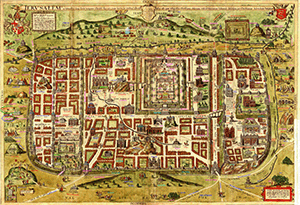
translation
Elohim –> God 하나님
Yahweh –> the Lord, 주
하늘님 -> 하느님 -> 하나님
|
P.1797 – §3 When the unbelieving Jews and the agents
of the Sanhedrin who had gathered about by this time heard these words,
they raised a tumult, shouting: "You are not fifty years of age,
and yet you talk about seeing Abraham; you are a child of the devil!"
Jesus was unable to continue the discourse. He only said as he departed,
"Verily, verily, I say to you, before Abraham was, I am." Many
of the unbelievers rushed forth for stones to cast at him, and the agents
of the Sanhedrin sought to place him under arrest, but the Master quickly
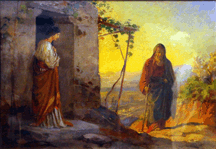
made his way through the temple corridors and escaped to a secret meeting
place near Bethany where Martha, Mary, and Lazarus awaited him. |
  |
|
8. THE VISIT WITH MARTHA AND MARY – P.1797
P.1797 – §4 It had been arranged that Jesus should
lodge with Lazarus and his sisters at a friend’s house, while the apostles
were scattered here and there in small groups, these precautions being
taken because the Jewish authorities were again becoming bold with their
plans to arrest him.
|
|
|
P.1797 – §5 For years it had been the custom for
these three to drop everything and listen to Jesus’ teaching whenever
he chanced to visit them. With the loss of their parents, Martha had assumed
the responsibilities of the home life, and so on this
P.1798 – §0 occasion, while Lazarus and Mary sat
at Jesus’ feet drinking in his refreshing teaching, Martha made ready
to serve the evening meal. It should be explained that Martha was unnecessarily
distracted by numerous needless tasks, and that she was cumbered by many
trivial cares; that was her disposition.
|
cumber, 방해하다.
care, (명사) 걱정거리
|
|
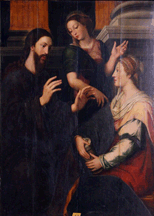
P.1798 – §1 As Martha busied herself with all these
supposed duties, she was perturbed because Mary did nothing to help. Therefore
she went to Jesus and said: "Master, do you not care that my sister
has left me alone to do all of the serving? Will you not bid her to come
and help me?" Jesus answered: "Martha, Martha, why are you always
anxious about so many things and troubled by so many trifles?
Only one
thing is really worth while, and since Mary has chosen this good and needful
part, I shall not take it away from her. But when will both of you learn
to live as I have taught you: both serving in co-operation and both refreshing
your souls in unison? Can you not learn that there is a time for everything–that
the lesser matters of life should give way before the greater things of
the heavenly kingdom?"
|
한 목소리로
|
|
9. AT BETHLEHEM WITH ABNER – P.1798
P.1798 – §2 Throughout the week that followed the
feast of tabernacles, scores of believers forgathered at Bethany and received
instruction from the twelve apostles. The Sanhedrin made no effort to
molest these gatherings since Jesus was not present; he was throughout
this time working with Abner and his associates in Bethlehem. The day
following the close of the feast, Jesus had departed for Bethany, and
he did not again teach in the temple during this visit to Jerusalem.
|
|
P.1798 – §3 At this time, Abner was making his headquarters
at Bethlehem, and from that center many workers had been sent to the cities
of Judea and southern Samaria and even to Alexandria. Within a few days
of his arrival, Jesus and Abner completed the arrangements for the consolidation
of the work of the two groups of apostles. |
headquarters (본부, 복수로 표현)
consolidate = con + solidare/solidus, 통합하다, 견고하게 만들다
|
|
P.1798 – §4 Throughout his visit to the feast of
tabernacles, Jesus had divided his time about equally between Bethany
and Bethlehem. At Bethany he spent considerable time with his apostles;
at Bethlehem he gave much instruction to Abner and the other former apostles
of John. And it was this intimate contact that finally led them to believe
in him. These former apostles of John the Baptist were influenced by the
courage he displayed in his public teaching in Jerusalem as well as by
the sympathetic understanding they experienced in his private teaching
at Bethlehem. These influences finally and fully won over each of Abner’s
associates to a wholehearted acceptance of the kingdom and all that such
a step implied.
|
believe in, 신뢰하다.
|
P.1798 – §5 Before leaving Bethlehem for the last
time, the Master made arrangements for them all to join him in the united
effort which was to precede the ending of his earth career in the flesh.
It was agreed that Abner and his associates were to join Jesus and the
twelve in the near future at Magadan Park.
|
cede, cedere (Latin) > go, give way |
P.1798 – §6 In accordance with this understanding,
early in November Abner and his eleven fellows cast their lot with Jesus
and the twelve and labored with them as one organization right on down
to the crucifixion.
|
cast lot with someone, 운명을 같이 하다 |
|
P.1798 – §7 In the latter part of October Jesus and
the twelve withdrew from the immediate vicinity of Jerusalem. On Sunday,
October 30, Jesus and his associates left the city of Ephraim, where he
had been resting in seclusion for a few days,
P.1799 – §0 and, going by the west Jordan highway
directly to Magadan Park, arrived late on the afternoon of Wednesday,
November 2.
|
|
|
P.1799 – §1 The apostles were greatly relieved to
have the Master back on friendly soil; no more did they urge him to go
up to Jerusalem to proclaim the gospel of the kingdom.
|
|
|
|
|