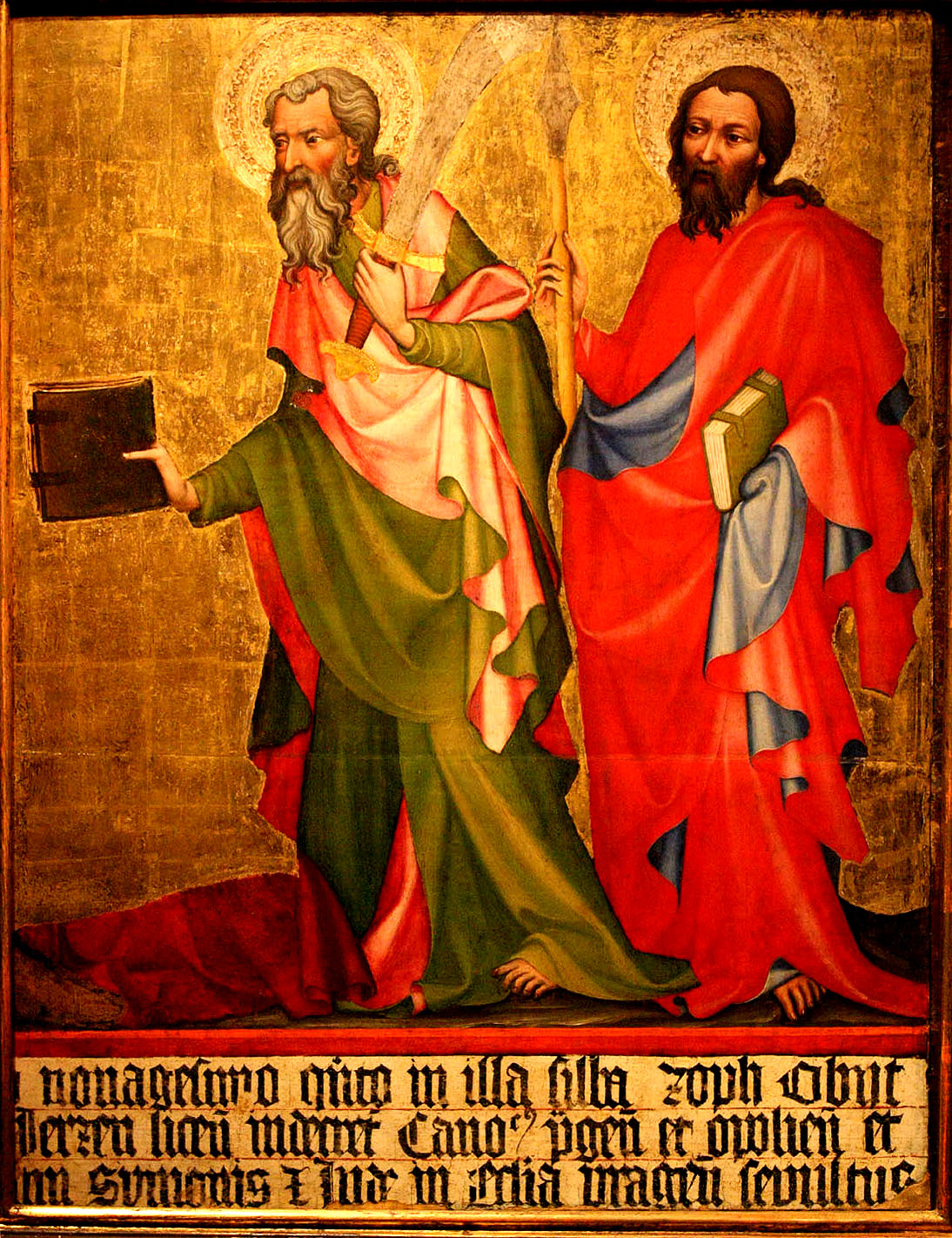
P.1783 – §1 On Sunday, September 25, A.D. 29, the
apostles and the evangelists assembled at Magadan. After a long conference
that evening with his associates, Jesus surprised all by announcing that
early the next day he and the twelve apostles would start for Jerusalem
to attend the feast of tabernacles. He directed that the evangelists visit
the believers in Galilee, and that the women’s corps return for a while
to Bethsaida.
P.1783 – §2 When the hour came to leave for Jerusalem,
Nathaniel and Thomas were still in the midst of their discussions with
Rodan of Alexandria, and they secured the Master’s permission to remain
at Magadan for a few days. And so, while Jesus and the ten were on their
way to Jerusalem, Nathaniel and Thomas were engaged in earnest debate
with Rodan. The week prior, in which Rodan had expounded his philosophy,
Thomas and Nathaniel had alternated in presenting the gospel of the kingdom
to the Greek philosopher. Rodan discovered that he had been well instructed
in Jesus’ teachings by one of the former apostles of John the Baptist
who had been his teacher at Alexandria.
|
secure, 확보하다
expound, ex + ponere (put), (어려운 것을) 설명하다
|
|
1. THE PERSONALITY OF GOD – P.1783
P.1783 – §3 There was one matter on which Rodan and
the two apostles did not see alike, and that was the personality of God.
Rodan readily accepted all that was presented to him regarding the attributes
of God, but he contended that the Father in heaven is not, cannot be,
a person as man conceives personality. While the apostles found themselves
in difficulty trying to prove that God is a person, Rodan found it still
more difficult to prove he is not a person.
|
  |
P.1783 – §4 Rodan contended that the fact of personality
consists in the coexistent fact of full and mutual communication between
beings of equality, beings who are capable of sympathetic understanding.
Said Rodan: "In order to be a person, God must have symbols of spirit
communication which would enable him to become fully understood by those
who make contact with him. But since God is infinite and eternal, the
Creator of all other beings, it follows that, as regards beings of equality,
God is alone in the universe. There are none equal to him; there are none
with whom he can communicate as an equal. God indeed may be the source
of all personality, but as such he is transcendent to personality, even
as the Creator is above and beyond the creature."
|
|
P.1783 – §5 This contention greatly troubled Thomas
and Nathaniel, and they had asked Jesus to come to their rescue, but the
Master refused to enter into their discussions. He did say to Thomas:
"It matters little what idea of the Father you may entertain as long
as you are spiritually acquainted with the ideal of his infinite and eternal
nature." |
무한 영원하다는 이상. |
|
P.1784 – §1 Thomas contended that God does communicate
with man, and therefore that the Father is a person, even within the definition
of Rodan. This the Greek rejected on the ground that God does not reveal
himself personally; that he is still a mystery. Then Nathaniel appealed
to his own personal experience with God, and that Rodan allowed, affirming
that he had recently had similar experiences, but these experiences, he
contended, proved only the reality of God, not his personality.
|
|
|
P.1784 – §2 By Monday night Thomas gave up. But by
Tuesday night Nathaniel had won Rodan to believe in the personality of
the Father, and he effected this change in the Greek’s views by the following
steps of reasoning:
P.1784 – §3 1. The Father in Paradise does enjoy
equality of communication with at least two other beings who are fully
equal to himself and wholly like himself–the Eternal Son and the Infinite
Spirit. In view of the doctrine of the Trinity, the Greek was compelled
to concede the personality possibility of the Universal Father. (It was
the later consideration of these discussions which led to the enlarged
conception of the Trinity in the minds of the twelve apostles. Of course,
it was the general belief that Jesus was the Eternal Son.)
|
아버지는 아들 및 영과 동등한 조건으로 교통한다.
concede, con (completely) + cedere (go, yield), 인정하다.
|
|
P.1784 – §4 2. Since Jesus was equal with the Father,
and since this Son had achieved the manifestation of personality to his
earth children, such a phenomenon constituted proof of the fact, and demonstration
of the possibility, of the possession of personality by all three of the
Godheads and forever settled the question regarding the ability of God
to communicate with man and the possibility of man’s communicating with
God.
|
|
|
P.1784 – §5 3. That Jesus was on terms of mutual
association and perfect communication with man; that Jesus was the Son
of God. That the relation of Son and Father presupposes equality of communication
and mutuality of sympathetic understanding; that Jesus and the Father
were one. That Jesus maintained at one and the same time understanding
communication with both God and man, and that, since both God and man
comprehended the meaning of the symbols of Jesus’ communication, both
God and man possessed the attributes of personality in so far as the requirements
of the ability of intercommunication were concerned. That the personality
of Jesus demonstrated the personality of God, while it proved conclusively
the presence of God in man. That two things which are related to the same
thing are related to each other.
|
one and the same time, 동시에 |
|
P.1784 – §6 4. That personality represents man’s
highest concept of human reality and divine values; that God also represents
man’s highest concept of divine reality and infinite values; therefore,
that God must be a divine and infinite personality, a personality in reality
although infinitely and eternally transcending man’s concept and definition
of personality, but nevertheless always and universally a personality.
|
human reality, 인간이 겪는 실체 |
|
P.1784 – §7 5. That God must be a personality since
he is the Creator of all personality and the destiny of all personality.
Rodan had been tremendously influenced by the teaching of Jesus, "Be
you therefore perfect, even as your Father in heaven is perfect."
|
|
|
P.1784 – §8 When Rodan heard these arguments, he
said: "I am convinced. I will confess God as a person if you will
permit me to qualify my confession of such a belief by attaching to the
meaning of personality a group of extended values,
P.1785 – §0 such as superhuman, transcendent, supreme,
infinite, eternal, final, and universal. I am now convinced that, while
God must be infinitely more than a personality, he cannot be anything
less. I am satisfied to end the argument and to accept Jesus as the personal
revelation of the Father and the satisfaction of all unsatisfied factors
in logic, reason, and philosophy."
|
convince, co + vincere (conquer), 확신시키다. |
|
2. THE DIVINE NATURE OF JESUS – P.1785
P.1785 – §1 Since Nathaniel and Thomas had so fully
approved Rodan’s views of the gospel of the kingdom, there remained only
one more point to consider, the teaching dealing with the divine nature
of Jesus, a doctrine only so recently publicly announced. Nathaniel and
Thomas jointly presented their views of the divine nature of the Master,
and the following narrative is a condensed, rearranged, and restated presentation
of their teaching:
|
신은 성격자이다. |
|
P.1785 – §2 1. Jesus has admitted his divinity, and
we believe him. Many remarkable things have happened in connection with
his ministry which we can understand only by believing that he is the
Son of God as well as the Son of Man.
|
|
|
P.1785 – §3 2. His life association with us exemplifies
the ideal of human friendship; only a divine being could possibly be such
a human friend. He is the most truly unselfish person we have ever known.
He is the friend even of sinners; he dares to love his enemies. He is
very loyal to us. While he does not hesitate to reprove us, it is plain
to all that he truly loves us. The better you know him, the more you will
love him. You will be charmed by his unswerving devotion. Through all
these years of our failure to comprehend his mission, he has been a faithful
friend. While he makes no use of flattery, he does treat us all with equal
kindness; he is invariably tender and compassionate. He has shared his
life and everything else with us. We are a happy community; we share all
things in common. We do not believe that a mere human could live such
a blameless life under such trying circumstances.
|
reprove = repriman (꾸짖다)
swerve, 갑자기 방향을 틀다
|
|
P.1785 – §4 3. We think Jesus is divine because he
never does wrong; he makes no mistakes. His wisdom is extraordinary; his
piety superb. He lives day by day in perfect accord with the Father’s
will. He never repents of misdeeds because he transgresses none of the
Father’s laws. He prays for us and with us, but he never asks us to pray
for him. We believe that he is consistently sinless. We do not think that
one who is only human ever professed to live such a life. He claims to
live a perfect life, and we acknowledge that he does. Our piety springs
from repentance, but his piety springs from righteousness. He even professes
to forgive sins and does heal diseases. No mere man would sanely profess
to forgive sin; that is a divine prerogative.
And he has seemed to be
thus perfect in his righteousness from the times of our first contact
with him. We grow in grace and in the knowledge of the truth, but our
Master exhibits maturity of righteousness to start with. All men, good
and evil, recognize these elements of goodness in Jesus. And yet never
is his piety obtrusive or ostentatious. He is both meek and fearless.
He seems to approve of our belief in his divinity. He is either what he
professes to be, or else he is the greatest hypocrite and fraud the world
has ever known. We are persuaded that he is just what he claims to be.
|
sane, 정신이 멀쩡한
hypocrite, < G: hupocrites, 위선자
prerogative < pre + rogare (ask)
obtrusive < obtrus (thrust forward)
|
|
P.1785 – §5 4. The uniqueness of his character and
the perfection of his emotional control convince us that he is a combination
of humanity and divinity. He unfailingly
P.1786 – §0 responds to the spectacle of human need;
suffering never fails to appeal to him. His compassion is moved alike
by physical suffering, mental anguish, or spiritual sorrow. He is quick
to recognize and generous to acknowledge the presence of faith or any
other grace in his fellow men. He is so just and fair and at the same
time so merciful and considerate. He grieves over the spiritual obstinacy
of the people and rejoices when they consent to see the light of truth.
|
spectacle < spectare (look)
obstinate < obstinare (persist) 완고한
|
|
P.1786 – §1 5. He seems to know the thoughts of men’s
minds and to understand the longings of their hearts. And he is always
sympathetic with our troubled spirits. He seems to possess all our human
emotions, but they are magnificently glorified. He strongly loves goodness
and equally hates sin. He possesses a superhuman consciousness of the
presence of Deity. He prays like a man but performs like a God. He seems
to foreknow things; he even now dares to speak about his death, some mystic
reference to his future glorification. While he is kind, he is also brave
and courageous. He never falters in doing his duty.
|
|
|
P.1786 – §2 6. We are constantly impressed by the
phenomenon of his superhuman knowledge. Hardly does a day pass but something
transpires to disclose that the Master knows what is going on away from
his immediate presence. He also seems to know about the thoughts of his
associates. He undoubtedly has communion with celestial personalities;
he unquestionably lives on a spiritual plane far above the rest of us.
Everything seems to be open to his unique understanding. He asks us questions
to draw us out, not to gain information.
|
draw us out, 이끌어내다 |
|
P.1786 – §3 7. Recently the Master does not hesitate
to assert his superhumanity. From the day of our ordination as apostles
right on down to recent times, he has never denied that he came from the
Father above. He speaks with the authority of a divine teacher. The Master
does not hesitate to refute the religious teachings of today and to declare
the new gospel with positive authority. He is assertive, positive, and
authoritative. Even John the Baptist, when he heard Jesus speak, declared
that he was the Son of God. He seems to be so sufficient within himself.
He craves not the support of the multitude; he is indifferent to the opinions
of men. He is brave and yet so free from pride.
|
|
|
P.1786 – §4 8. He constantly talks about God as an
ever-present associate in all that he does. He goes about doing good,
for God seems to be in him. He makes the most astounding assertions about
himself and his mission on earth, statements which would be absurd if
he were not divine. He once declared, "Before Abraham was, I am."
He has definitely claimed divinity; he professes to be in partnership
with God.
He well-nigh exhausts the possibilities of language in the reiteration
of his claims of intimate association with the heavenly Father. He even
dares to assert that he and the Father are one. He says that any one who
has seen him has seen the Father. And he says and does all these tremendous
things with such childlike naturalness. He alludes to his association
with the Father in the same manner that he refers to his association with
us. He seems to be so sure about God and speaks of these relations in
such a matter-of-fact way.
|
absurd < surdus (deaf), out of tune
claim divinity, 신성을 주장하다
well nigh, 거의 (문어체)
matter-of-fact way, 사무적인 방법으로
|
|
P.1786 – §5 9. In his prayer life he appears to communicate
directly with his Father. We have heard few of his prayers, but these
few would indicate that he talks with God, as it were, face to face. He
seems to know the future as well as the past. He simply could not be all
of this and do all of these extraordinary things
P.1787 – §0 unless he were something more than human.
We know he is human, we are sure of that, but we are almost equally sure
that he is also divine. We believe that he is divine. We are convinced
that he is the Son of Man and the Son of God.
|
as it were, 말하자면,
face to face, 얼굴을 맞대고
mano a mano, 1대1로, hand-to-hand combat.
|
|
P.1787 – §1 When Nathaniel and Thomas had concluded
their conferences with Rodan, they hurried on toward Jerusalem to join
their fellow apostles, arriving on Friday of that week. This had been
a great experience in the lives of all three of these believers, and the
other apostles learned much from the recounting of these experiences by
Nathaniel and Thomas.
|
School of Alexandria (Britannica: the first Christian institution of higher learning, founded in the mid 2nd century AD in Alexandria.
Pantaenus, Clement and Origen.
(alegorical interpretation
|
|
P.1787 – §2 Rodan made his way back to Alexandria,
where he long taught his philosophy in the school of Meganta. He became
a mighty man in the later affairs of the kingdom of heaven; he was a faithful
believer to the end of his earth days, yielding up his life in Greece
with others when the persecutions were at their height.
|
  |
|
3. JESUS’ HUMAN AND DIVINE MINDS – P.1787
P.1787 – §3 Consciousness of divinity was a gradual
growth in the mind of Jesus up to the occasion of his baptism. After he
became fully self-conscious of his divine nature, prehuman existence,
and universe prerogatives, he seems to have possessed the power of variously
limiting his human consciousness of his divinity. It appears to us that
from his baptism until the crucifixion it was entirely optional with Jesus
whether to depend only on the human mind or to utilize the knowledge of
both the human and the divine minds. At times he appeared to avail himself
of only that information which was resident in the human intellect. On
other occasions he appeared to act with such fullness of knowledge and
wisdom as could be afforded only by the utilization of the superhuman
content of his divine consciousness.
|
prerogatives < pre + rogare (ask), 특권
|
P.1787 – §4 We can understand his unique performances
only by accepting the theory that he could, at will, self-limit his divinity
consciousness. We are fully cognizant that he frequently withheld from
his associates his foreknowledge of events, and that he was aware of the
nature of their thinking and planning. We understand that he did not wish
his followers to know too fully that he was able to discern their thoughts
and to penetrate their plans. He did not desire too far to transcend the
concept of the human as it was held in the minds of his apostles and disciples.
|
discern < dis(apart) +cernere (separate), 파악하다. |
|
P.1787 – §5 We are utterly at a loss to differentiate
between his practice of self-limiting his divine consciousness and his
technique of concealing his preknowledge and thought discernment from
his human associates. We are convinced that he used both of these techniques,
but we are not always able, in a given instance, to specify which method
he may have employed. We frequently observed him acting with only the
human content of consciousness; then would we behold him in conference
with the directors of the celestial hosts of the universe and discern
the undoubted functioning of the divine mind.
And then on almost numberless
occasions did we witness the working of this combined personality of man
and God as it was activated by the apparent perfect union of the human
and the divine minds. This is the limit of our knowledge of such phenomena;
we really do not actually know the full truth about this mystery.
|
activate, 활성화하다.
신과 인간의 지성이 어떻게 작용하는가 모른다.
|
| |
|